
In a recent article, we wrote that ETH volatility was “sort of” back, after reaching a multi-year low. Although participants were already starting to panic a bit, DVOL had just barely climbed back into the previous years’ general range, and the options market was still implying heightened short-term fears to the downside. In the following trading session, the market gave just that. ETH faced a double-digit red day down into the 1500s, with DVOL spiking even further to the 70s, more than 50% higher than it was just 11 days prior. After processing such a large move, DVOL has yet again reverted to the mid-50s, a reading that has only been lower roughly 15% of the time over the last year. With such large swings in the market, it is a good opportunity to look at how this impacts some entities that actually utilize options strategies for their treasuries.
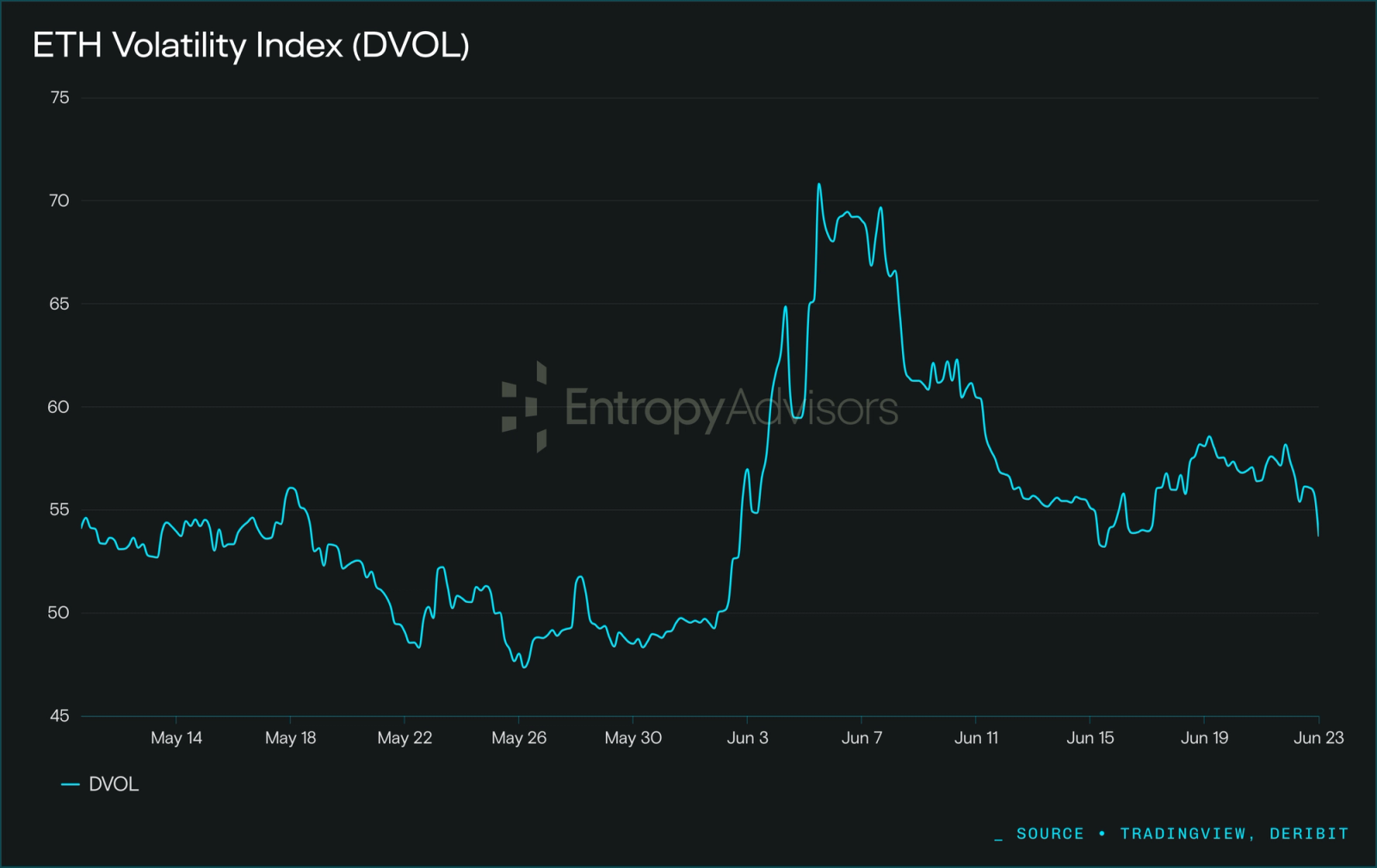
One point we made in the initial piece that could have been easy to miss: vol spiking doesn’t automatically help a treasury or entity that is utilizing vol strategies as part (or even a majority) of its deployments. The obvious point to make is that almost no amount of premium earned over the long run in simple call overwriting is going to compensate for the lost notional value when the base asset drops in price, but there are many more dynamics simultaneously at play.
Typically, during these sharper vol events, it’s the front-end put skew blowing out, while calls further out (often used for operational simplicity by entities leveraging options) stay relatively cheap, meaning often there’s not even a commensurate uptick in premiums received to account for a sharp overall vol spike that could leave you assigned below market.
Most discussions of options and derivatives usage in crypto are centered around individual traders, hedge funds, and prop shops using them as discretionary tools to augment exposures across a range of outcomes. DAOs, Foundations, Protocols, DATs, and Miners run into very different problems depending on what they hold and why they hold it.
Whether it’s a clear-cut goal to maximize holdings per share or a mandate/IPS meant to balance several occasionally conflicting goals, options provide a diverse opportunity set for entities addressing financial or strategic needs through various market regimes. For many of them, options are less a yield product and more of a decision-making tool: a way to insulate themselves from making hard, discretionary calls. A way to sell without signaling a dump, to extend runway without liquidating outright, to accumulate without spot market buys, or to get paid for views they already hold.
The premiums can be pretty substantial “income,” but as always in markets (and life), there’s no free lunch. In the first entry to this series, we’ll explore the basic concepts treasuries must understand and use when utilizing options.
1. Quick Refresher on Volatility
Too often, options are boiled down to just the basic end outcomes of transacting a call or a put. The part that matters, and the part that many treasuries underweight, is that when you buy or sell an option, you’re not simply buying the right (or taking on the obligation) to transact at a certain price in the future. You’re trading volatility. Strip away the strike, spot, and time to expiry, and what’s left of the premium largely comes down to one thing: how much movement the market expects between now and expiry. Before we discuss any of the often-used structures, it’s worth re-establishing some key points about “vol” and how it relates to strategies used by treasuries.
Implied vs Realized: The two main vol figures we look at. Realized volatility is how much the asset actually moved over a period of time, and is a backward-looking measurement. Implied volatility is the market’s expectation of future movement, backed out of option pricing, and is forward-looking. For ETH, the headline unit-of-measurement we often cite is the DVOL index, Deribit’s 30-day forward-looking implied vol index (crypto’s analog of sorts to the VIX), which is constructed from prices of several options.
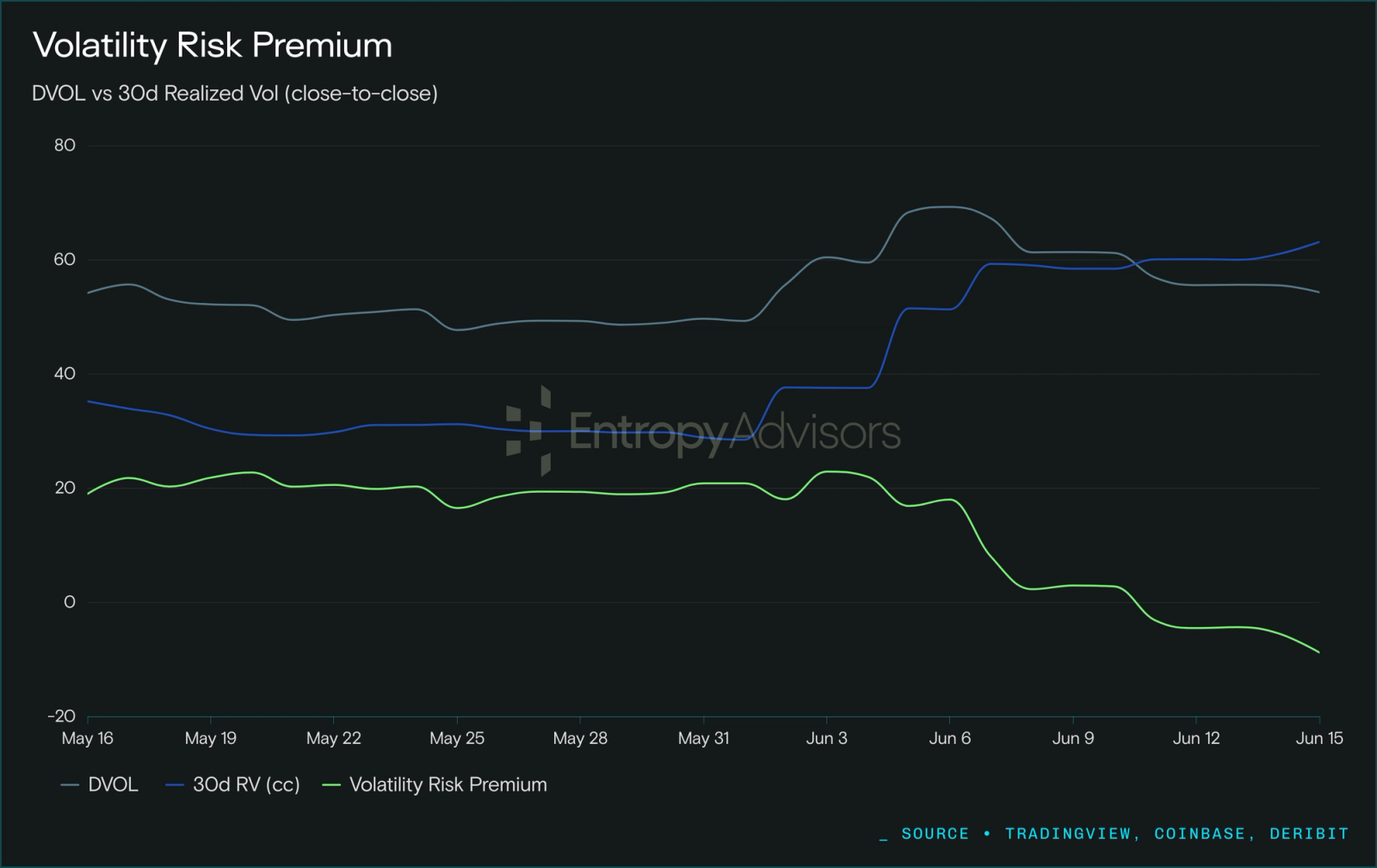
When we talk about DVOL rising, we mean that the implied vol in the market climbed, and although this often happens as a result of realized vol changing, there isn’t a perfect connection. The spread between these two figures is the volatility risk premium, and it’s one of the larger inputs when determining how much a seller is getting compensated for taking on that risk. In the below example, one can see how the VRP actually decreased in the first couple weeks of June despite the violent price action, as realized volatility caught such a large bump that the spread entirely compressed down into negative territory.
Although DVOL (reminder, a fixed 30-day measure) jumped, on a horizon-matched basis sellers were being relatively undercompensated compared to when DVOL itself was lower. That said, a negative reading isn't necessarily as bad for sellers as it initially looks. A brief inversion is typical after a large move, since trailing realized spikes on the selloff while implied already prices in that most of the move has passed. That spread does tend to revert as those days roll out of the window. However, much of the vol bid did remain concentrated in shorter tenors than what DVOL captures.
So what determines IV, then? Why aren’t IVs the same across strikes? Shouldn’t there be one implied volatility for ETH for a certain expiry date?
The market doesn’t price all outcomes perfectly symmetrically. Downside strikes for puts and upside strikes for calls carry different IVs depending on which tail participants are paying up to hedge or directionally bet on. That asymmetry in directions is skew (covered below). The general level of vol meanwhile, is driven by a variety of factors: realized movement, demand for hedges, leverage and positioning, liquidations, and well-known timed catalysts such as macro prints, unlocks, and major protocol events. Vol is its own asset with its own supply and demand of sorts, distinct from the plain directionality of spot.
Buying versus selling vol carries different considerations and implications. Selling calls or puts means collecting premiums up front in exchange for taking on the risk of assignment. For covered calls, this means capping upside and the risk of selling below market (opportunity cost), and for puts, it’s an obligation to buy at a higher price than where the market is trading at the time of expiry. There is a recurring danger of being run over in a sharp move that offsets what can be comparably small premiums collected.
It’s worth noting that there are several distinct camps actually buying and selling vol. Many large participants are trading vol, delta-hedging away directional exposures so they’re left net long or short volatility itself, while others use options for directional exposure. Treasuries, DAOs, Foundations, and similar entities often sit in a third hybrid bucket. They’re generally holding large amounts of unissued native tokens that they need to float to the market at some point to cover expenses, and options can be used to express a view of at what price and on what timeframe this can happen, while the entities collect returns via premiums.
Skew, explained in one extreme oversimplification, tells you which side is “scared” or willing to “pay up” for their views. Skew is the relative richness in IVs of puts versus calls at the same relative distances from spot. Puts are often heavily bid in times of fear as “crash insurance,” meaning that even with huge vol spikes, treasuries routinely selling longer-dated calls in the wings don’t necessarily benefit. Looking at skew tells you where the market is willing to pay up for upside or downside over any given time frame, and helps inform which structures are cheap or expensive to build out at any given time.
Looking at market metrics such as absolute vol levels, volatility risk premium, and skew, alongside evaluating an organization’s capital needs from first principles and directional view on the native token’s perceived fair value compared to current market price, is what primarily dictates whether some of these structures can make sense at any given time. Broadly speaking, when IV is rich, and there is a firm reason to be on the “other side” of a potential move (wanting to monetize, structurally long the asset by mandate and wanting income/can bear assignment risk) is generally the setup desired for selling premiums. On the other hand, one would generally look to buy premiums (especially puts for downside protection) when IV is cheap relative to the risk carried on the book and put skew isn’t blown out versus historical comps.
2. “The Seller’s Problem” - Why a DAO/Foundation Can’t “Just Sell”
Let’s start with the most common situation: a Treasury sitting on a huge pile of its own unissued token. In a lot of cases, the overwhelming majority of any treasury is highly concentrated in their native token, oftentimes even higher than 90%. For DAOs, this is almost always the case.
Foundations or Labs entities typically have stronger cash balances, thanks to being recipients of raised capital and token-sale proceeds, but as expenses denominated in USD occur over years, continued operations often become reliant on the native token again.
This is partially a function of how most crypto entities are financed and the young age of the industry. Traditional companies raise large cash piles in several funding rounds spaced out over long intervals, operating off the runway between each round. It’s not uncommon to take on down rounds or bridge loans when cash needs materially ramp up while the runway is starting to shrink. Crypto has largely gone the other way as an industry, often opting for just-in-time liquidity. Instead of sitting on a large diversified treasury, DAOs and foundations hold a large number of their own unissued tokens and float them gradually to attain operating capital as needed through semi-regular sales. While this structure provides a lot of financial flexibility and can be seen as capital-efficient on paper, you run into some core problems, mostly notably that you can lose the ability to float tokens opportunely in advance of needs when the market is valuing them richly.As we have repeatedly noted in the past on governance proposals for the Arbitrum DAO’s Treasury, one of the core reasons why treasury management is so important is to grow non-native asset balances to provide stability for operations while earning treasury management yields. An entity’s cash needs tend to be the highest when protocol performance is lackluster. During these times, relying on just-in-time liquidity means that you end up floating tokens at low valuations because token prices typically have a direct relationship with performance. This effect compounds notably further with market cycles if the treasury holds other volatile assets, given that your assets’ value decreases in a bear market when protocols also tend to perform worse.
No matter the market cycle, there’s a problem with selling without market guidance: working through tough optics, governance, and running the risk of greatly impacting investor/holder sentiment and ability to forecast the future (and positive sentiment goes a long way in crypto). Outright sales of spot tokens are generally a very undesirable option, as it creates direct negative price pressure and are all but guaranteed to be perceived negatively by the community, no matter the end goal of the funds.
Simply put, indicating a large float increase or having the single largest holder announce a sale moves markets. Look at Bitcoin around Saylor’s actions at the beginning of the month. Simply disclosing a 32 BTC “test” equivalent sale on June 1st was enough to largely impact BTC and STRC prices the following week (displayed below). Not by the direct flows on the market, given the trivial size of BTC sold, but from second-order effects: the expectation of future sales. This is exactly the sentiment and confidence issue that can arise from the largest holder initiating even small sales to meet obligations.
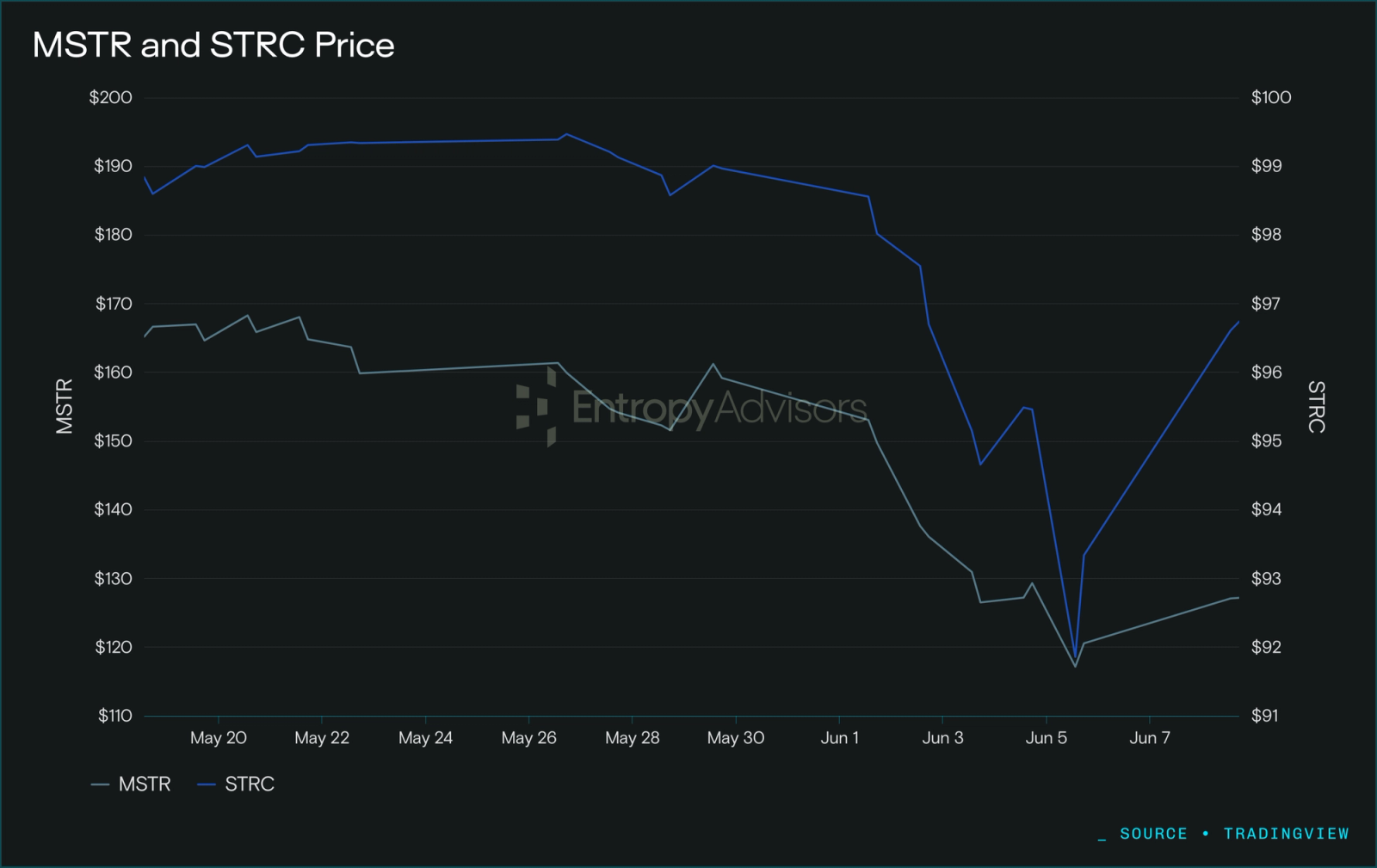
Now, start thinking about an entity that holds, or has the ability to float, a much higher relative percentage of the asset with an exponentially thinner liquidity profile on the market. There is most likely going to be an outsized impact.
This isn’t just a problem for small-cap assets. It remains true for the majors, too. Take the Ethereum Foundation, for example. This is probably the most notable non-MSTR example of an entity facing criticism for selling its crypto assets. It became essentially a self-fulfilling prophecy (and meme) in previous years that EF transfers of ETH to Kraken had the potential to set local tops and stop rallies. It took several years of criticism for the EF to announce the usage of their capital in DeFi to extend runway, ranging from staking to supplying in DeFi protocols, and symbolically borrowing against ETH (albeit in small size), rather than outright selling. To this day, these actions have not entirely supplanted spot sales, but there is now an expanded toolkit.
A counter-example: to keep our views balanced, a recent example of sales actually “working out well” is Morpho. The Morpho Association recently disclosed a $175M raise, co-led by Paradigm, a16z crypto, and Ribbit Capital. The round valued the protocol comparable to market pricing (30d rolling), and importantly, it was not structured as an equity raise but as an OTC token purchase. Rather than the repeated smaller sales we alluded to earlier (“just-in-time liquidity” model), this was a single large raise, much closer to how traditional companies finance themselves. Because these tokens were allocated at genesis within the token supply split but had never circulated, it functions equivalently to a company selling unissued shares, expanding the investor base with aligned holders rather than dumping existing float onto the open market.
Even after what Morpho co-founder Merlin Egalite called “the largest raise in DeFi history,” providing $175M in usable capital for growth and building the “open credit network of the world,” they are still not immune to the criticisms surrounding sales. Some commended Morpho for following governance procedures clearly, asking for tokens from the DAO for development and growth, and making a strategic financial planning move, while others cited that the short, broad text to explain the use of several hundred million dollars of tokens did not explicitly mention that they would be sold to investors.
Despite the active discussion and split between criticism and support, MORPHO as an asset actually made out very well from this outcome. We’d stress this is a bit of an outlier, though. This was a calculated sale, open only to some of the most influential backers, and transactions occurring at market pricing (not a discount) signaled a vote of confidence in the asset. Most situations do not play out this way, and there’s a broader lesson other projects could take away from it.
By structuring capital raises in this manner (a deliberate, large-size sale rather than constant small float increases), it makes it far easier for investors to enter or continue holding positions. Clear, defined guidance with actual intent behind sales instead of vaguely continuing to support operational expenditures allows for holders to build confidence for two reasons. Firstly, from a flows perspective, there is less fear of constant supply-side pressure outpacing demand. A second, less mechanical, but notable, effect is that it serves to reinforce confidence in the proficiency of both leadership and operations, aligning holders with a clearly understood north star and usage of proceeds. This dramatically lowers perceived uncertainty and risk from a financial and operating health standpoint, and thus makes for easier underwriting of the asset.
3. Strategic Monetization via Call Overwriting
Given the above, a common workaround is to reframe the issue by utilizing covered calls. If a treasury shares with the community or DAO that they plan on monetizing some of their token to raise cash or pay for operational needs, it’s not uncommon for traders to want to get out of the way of the freight train. “Let the biggest footprint seller finish up, I already know that’ll move the price - I’ll get in later.” This serves as a problem in its own right. For entities that have to telegraph sales ahead of time and get governance approval, it makes execution much less efficient since more units of the underlying may need to be sold to hit the same dollar target.
It’s worth delineating what actually drives the negative reaction here, though. The market doesn’t necessarily punish monetization in and of itself. If guidance is communicated thoroughly, there’s a clear and credible use of proceeds, and sizing reasonably matches those needs, then raising operating capital is often received just fine. In fact, in outlier cases where monetization coincides with large-scale future initiatives and aligns stakeholders for the long-term (as in the above example with Morpho), it can even be received generally positively.
The problem almost always traces back to entities monetizing without a plan, at the wrong size, or funneling the proceeds into things the market doesn’t trust them to realistically execute. Worse yet, a combination of these factors while the token is trading at new lows runs the risk of being interpreted as desperation or salvaging what value they can. Much of the “selling is bad” stigma in crypto is a result of what foundations and DAOs have unfortunately earned by doing widely unproductive things with the money.
Here’s where the optical reframing utilizing covered calls comes in. There’s a very stark difference between:“We’re planning on floating $10M of our asset in 7 days to fund operations” versus:“We’re open to floating at a much higher valuation later, and we’ll even get paid premiums right now for waiting.”The second version comes across as less instantly actionable and less bearish than any alternative monetization plan. This is especially true compared to locked token sales at discounts, where the optics actually anchor price expectations in the opposite direction, no matter the circumstances of a token being rangebound, uptrending, or downtrending. “They’re expecting the token to be HOW MUCH lower in 3 months from now?”
The huge caveat here, of course, is that this only works as a monetization strategy if the token actually rises in price. If it doesn’t, premiums alone can only materially make a dent and raise operating budget if they are quite well-capitalized in their token to begin with.
Beyond the messaging and optics, it genuinely helps organizations turn selling into a disciplined, pre-planned process rather than a hasty, discretionary decision made by individuals with conflicting real-time views. Instead of reassessing and arguing market structure each time a sale is deliberated, a treasury can choose to stagger strikes and expiries and scale out only at attractive prices. In this fashion, it can be casually seen as a bit of a limit order that pays you to wait. Used this way, covered calls aren’t necessarily a trick to “disguise” a sale. Instead, they’re a way to make monetization disciplined and structured, reflecting a strong ability to forecast future capital needs in various market climates.
There are downsides and considerations to the strategy (more later - again, no free lunch), but we’ve internally seen smart covered-call usage for a treasury as a “win-win-win”, where each of the three outcomes having their own specific benefit.
- Price Falls after Option Sale: you were likely going to weather the drawdown regardless due to politics, decision making, and bias against selling the asset “before it recovers” or under “fair value.” At least you generated some income and brought USD in while drawing down in the native token.
- Price Rises but Stays Under the Strike: This is the ideal case, setting aside runway considerations and assuming the entity isn’t outright using this as a tool to sell. No new tokens are floated, and the treasury keeps the premium on top
- Price Exceeds Strike, Expires ITM: The tokens get called away, and sold “below market,” but at a price determined in advance as a good place to sell. The rest of the treasury, whether issued and on the balance sheet or unissued, appreciated too. Now the treasury has diversified its assets and grown its cash balance in a rally.
4. “Monetization” vs “Yield” - The Delta Decision
The exact same covered call toolkit described above can actually be utilized in two very different ways, completely dependent on the end goal of the treasury. It all comes down to the delta selection.
Monetization (Higher Delta): Strikes closer to the money (higher delta) are essentially a way of expressing “I want to monetize this asset, just not at these prices.” It’s a limit order of sorts with a premium and fixed timeframe attached (reminder: options within crypto are European, not American, so not exercisable pre-expiry). With much higher odds of assignment, this should be treated as an intended sale, not a recurring, sustainable program where “yield” can be communicated and projected as a base case.
Repeatable “Yield” (Lower Delta) To make this a recurring income program, treasuries go further out, which means substantially smaller premiums but a much higher chance of keeping the asset and doing it again the next month. The catch here is also optical as much as it is financial. Leaning into consistent vol selling with one’s own token, or a major ecosystem token like ETH or SOL, can pretty easily be interpreted as “you have a bearish tilt and are choosing to actively use capital with OTC desks to pick up a few percent instead of supporting your ecosystem with those funds.” The opportunity cost versus strategic usage like bootstrapping new protocols, giving grants out to teams, or bolstering liquidity becomes a lot more real in this situation.
Indicatively, for a rough example of how choosing deltas can drastically alter the program: looking at 25-35 delta strikes for monetization would mean an entity is okay with selling sooner, whereas they may want to look at 15-25 delta for more repeatable yield. The lower end of deltas is a more defensible default for a “mandated to hold” treasury. Aside from an exposure/hedge ratio, delta is also commonly used as a rough proxy for the probability of expiring ITM. At 30-35 delta, you’re realistically getting called away a few times a year on a rolling program utilizing monthlies, whereas in the 15-25 delta range, you preserve more buffer to ride a rally without losing the underlying and maintain the flexibility to roll/reset the strikes further upward as you approach expiry. Because delta moves with vol, targeting a fixed delta rather than a fixed % OTM means you automatically sell further out when IVs are richer but pull in a bit when vol contracts. So as IV rises, the same delta corresponds to a higher strike.
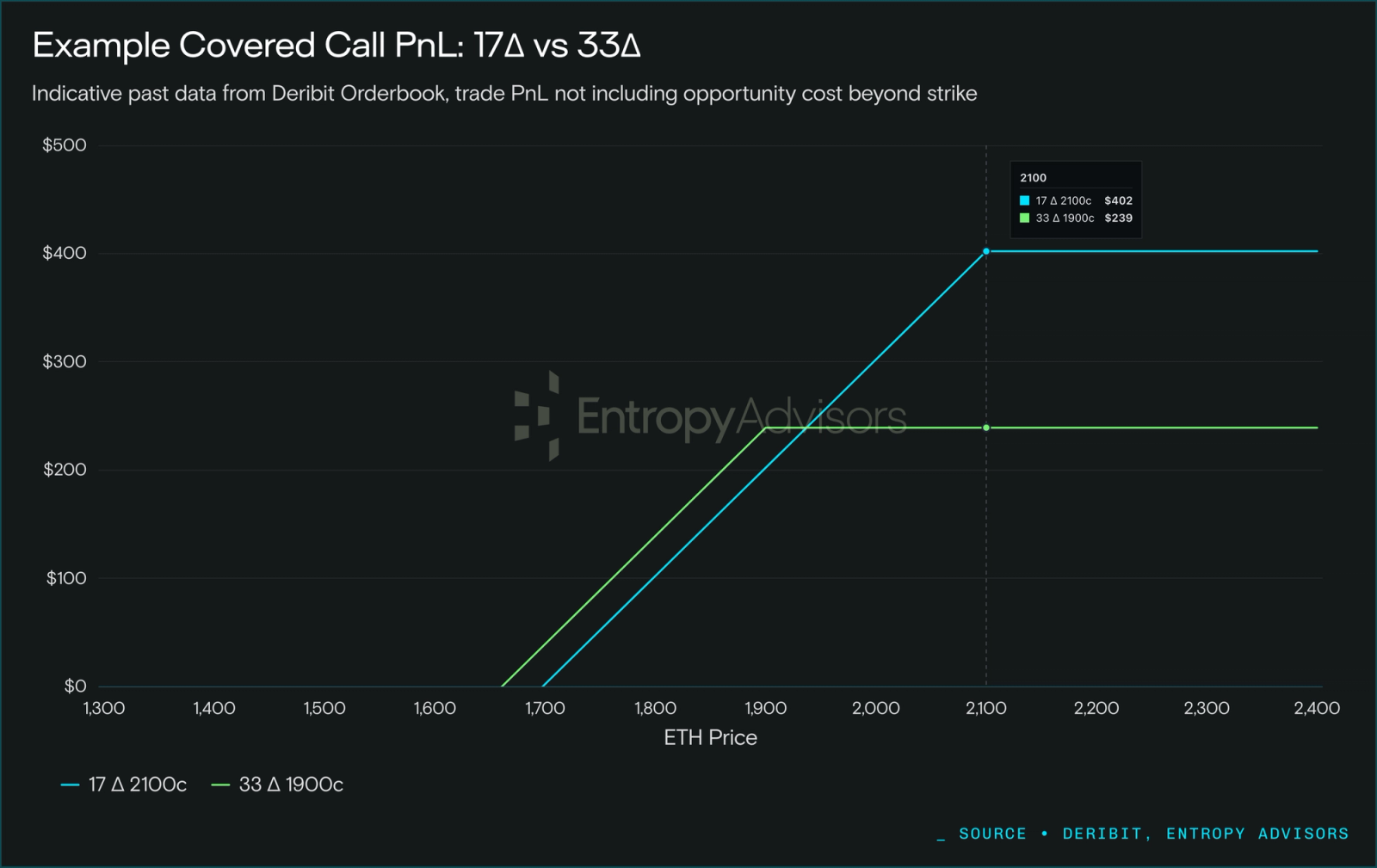
For a practical, real-world example, let’s look at Deribit orderbook data for ETH. For this example, with ETH spot referenced at ~$1722, looking at 31Jul26 (45 days to expiry at time of writing), a 33delta call (10.3% OTM) showed a premium of 3.55% (~$61), whereas a 17delta call (22% OTM) of the same expiry showed a premium of only 1.4% (~$24).
For an asset like ETH, it may be tempting to chase the higher delta’s premium, given seeing a headline premium figure of 3.55% surpasses what would be earned in an entire year of staking ETH by a full percentage of yield earned in only 45 days. It can be even more alluring to annualize these figures and say that 3.55% over a month and a half equates to ~28% annualized, but it isn’t exactly intellectually honest to do so. Remember the point above, using delta as a proxy for probability of expiring ITM. With an implied ~1/3 odds of assignment each cycle, one would expect over several monthlies sold per year to actually be called away multiple times.
It’s extremely important that outcomes and opportunity costs in the case of assignment be determined first and foremost, rather than being dragged in by up-front premiums. While it is true that utilizing lower delta calls in this situation would yield less than half of the premiums as the higher delta strike at t=0, one must plan ahead for a variety of market outcomes and see each respective PnL in the case of assignment to see where it gets capped. In the example case below, one can see that chasing an extra ~$37 in premiums upon sale can easily get dwarfed in the case of an actual sharp ETH rally. The max profit, despite the higher premiums received, is $239 for the 33delta call, and $402 for the 17delta call. This is a difference of $163 per ETH, an opportunity cost nearly 5x larger than the initial difference in extra premiums received for choosing the higher delta strike.
The same rings true for different reasons with going too far OTM. Over-optimizing for not getting assigned genuinely leaves “money on the table” if generating meaningful income is a core goal of the program. Sure, IVs generally tick up as the strikes get further out, but the dollar premium still shrinks down closer to zero. As the premiums compress further and further, the opportunity cost vs strategic deployments only grows larger. Depending on the entity’s exact role or responsibility in utilizing funds to support the ecosystem, this can be a real cost in two directions.
The first is primarily reputational and strategic. A foundation or treasury that chooses to cap its own upside in a rally would have to answer angry tokenholders, builders, and stakeholders who watched the asset run while the balance sheet didn’t get to participate in the upside, and at the same time, the capital wasn’t used productively to help fund novel development, real initiatives, or ink partnerships. There’s a real cost connected to missing out on fundamental growth, and this can often be directly measured by the cost of attracting liquidity or closing deals.
The second, more dangerous cost is the structural “pennies in front of a steamroller” effect. Harvesting small, steady income is beneficial, but it is always bounded, and usually not too significant. The opportunity cost, while rare, has potential to be massive. For an entity that is supposed to be long-term aligned with the asset, missing out on a generational recovery rally after years of depreciation and not monetizing then would be far harder to justify than missing out on a small amount of premium or yield every month.
For this reason, delta choices remain incredibly important for those conducting a call overwriting program, and like most decisions in trading and investing, sizing is the most important piece of the equation.
What We’ll Cover Next:
This piece only covers some of the core DAO/Foundation/Protocol strategies within the options toolkit. Future topics we plan to cover in the next follow-up:
- DATs, Miners, and Selling puts to accumulate
- Risk-adjusted yield comparison: Derivatives vs On-Chain
- The covered-call ETF lesson
- More advanced structures
This article is provided solely for informational purposes. The statements and materials contained herein do not constitute financial, investment, legal, or tax advice, nor do they represent an offer, solicitation, or recommendation to buy or sell any product, service, or asset. The information presented does not provide any advice, representation, warranty, certification, guarantee, or promise relating to the subject(s) of such statements. No representation or warranty of any kind (whether express or implied) is given as to the accuracy or completeness of this article, and no party should rely on its contents for making any decisions, whether financial, legal, or otherwise.