The Arbitrum DAO is one of the largest and most decentralized organizations in crypto, but for most of its history it has carried a structural vulnerability familiar to nearly every token-governed treasury: a balance sheet denominated almost entirely in its own native asset. Over the past two years, the DAO has been quietly rebuilding that foundation. Today, roughly 30% of its revenue comes from sources that did not exist when the DAO launched, and its treasury holds a meaningful share of ETH, stablecoins, and real-world assets alongside ARB.
This post walks through how that shift happened, where the DAO stands today, and how Entropy is helping drive Arbitrum towards a more sustainable revenue model.
A Quick Primer on Who Governs Arbitrum
The ARB token governs the Arbitrum DAO and its treasury. Holders can vote directly on proposals or delegate their voting power to representatives. Today, the DAO has thousands of delegates and more than 320 million ARB in total delegated voting power.
What makes Arbitrum stand out, even among large DAOs, is the diversity of its top delegates. The leaderboard includes a mix of protocols, research firms, market makers, and investors: GMX, Camelot, L2Beat, Blockworks, Wintermute, Gauntlet, Pantera, and GFX Labs, among many others including Entropy Advisors.
While Entropy’s initial mandate was to reduce operational chaos and facilitate execution of programs in the DAO, in August of 2025 the partnership was extended for another two years, with a renewed focus on treasury management, incentive design, data analytics, and special projects in coordination with Offchain Labs, the Arbitrum Foundation, and ecosystem builders.
Two Types of Proposals, One Shared Treasury
Proposals in the DAO fall into two categories. Constitutional proposals affect the core network, smart contracts, and the Arbitrum tech stack while non-constitutional proposals are those that require funding from the DAO.
Over its lifespan, the DAO has allocated more than $800 million across 50+ proposals covering investments, incentives, and partnerships.
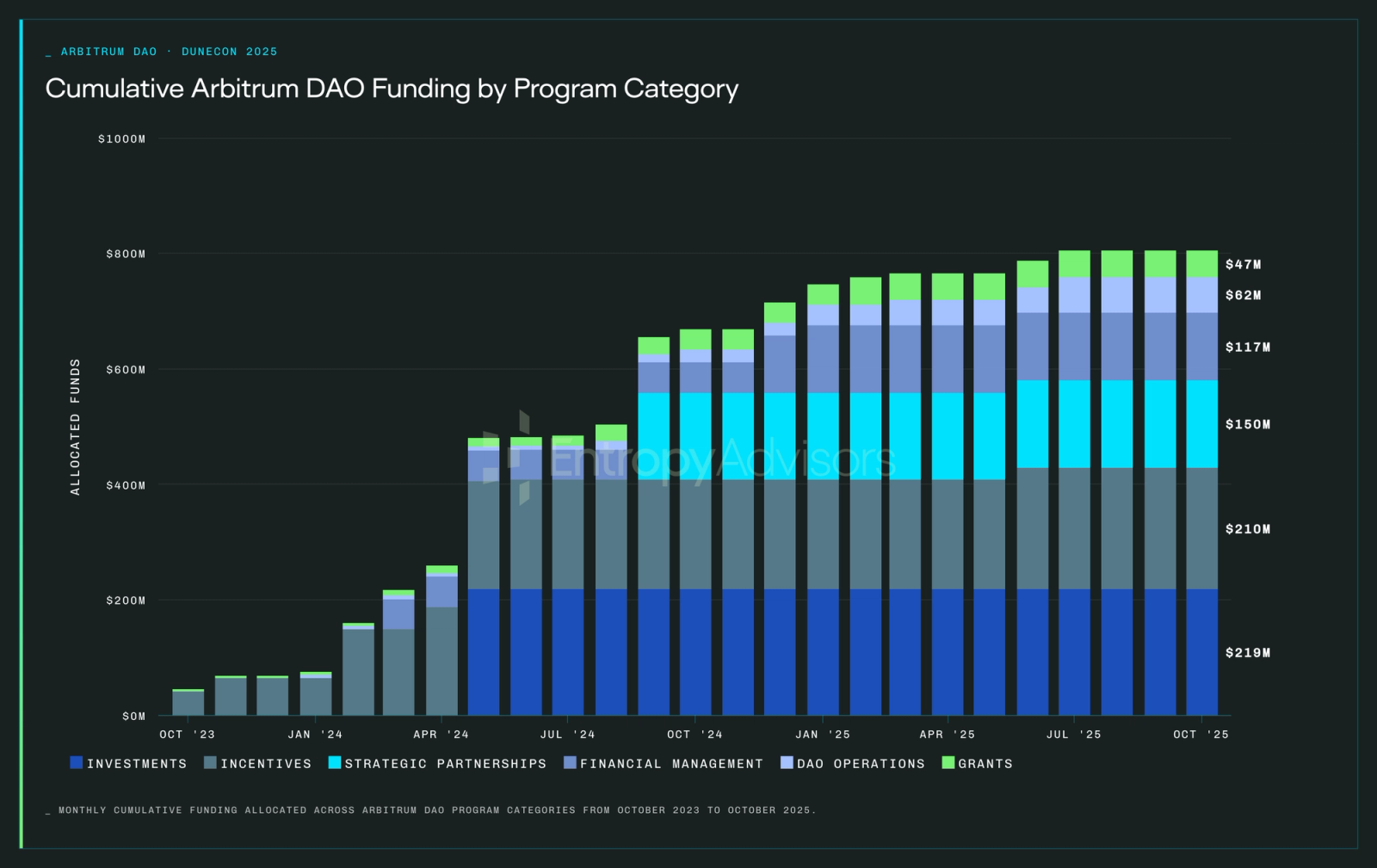
Note: These figures reflect value at the time of allocation, not at the time of spend. Recipients typically deploy funds over months or years, and any unspent balance returns to the DAO at the close of an initiative.
The natural follow-up question: where does that money come from?
The Treasury, and Why It Needed to Change
The DAO's treasury is a smart contract on the Arbitrum One chain that contains assets collectively controlled by the Arbitrum Dao. At genesis, it received 35% of the ARB total supply, or 3.5 billion ARB tokens.
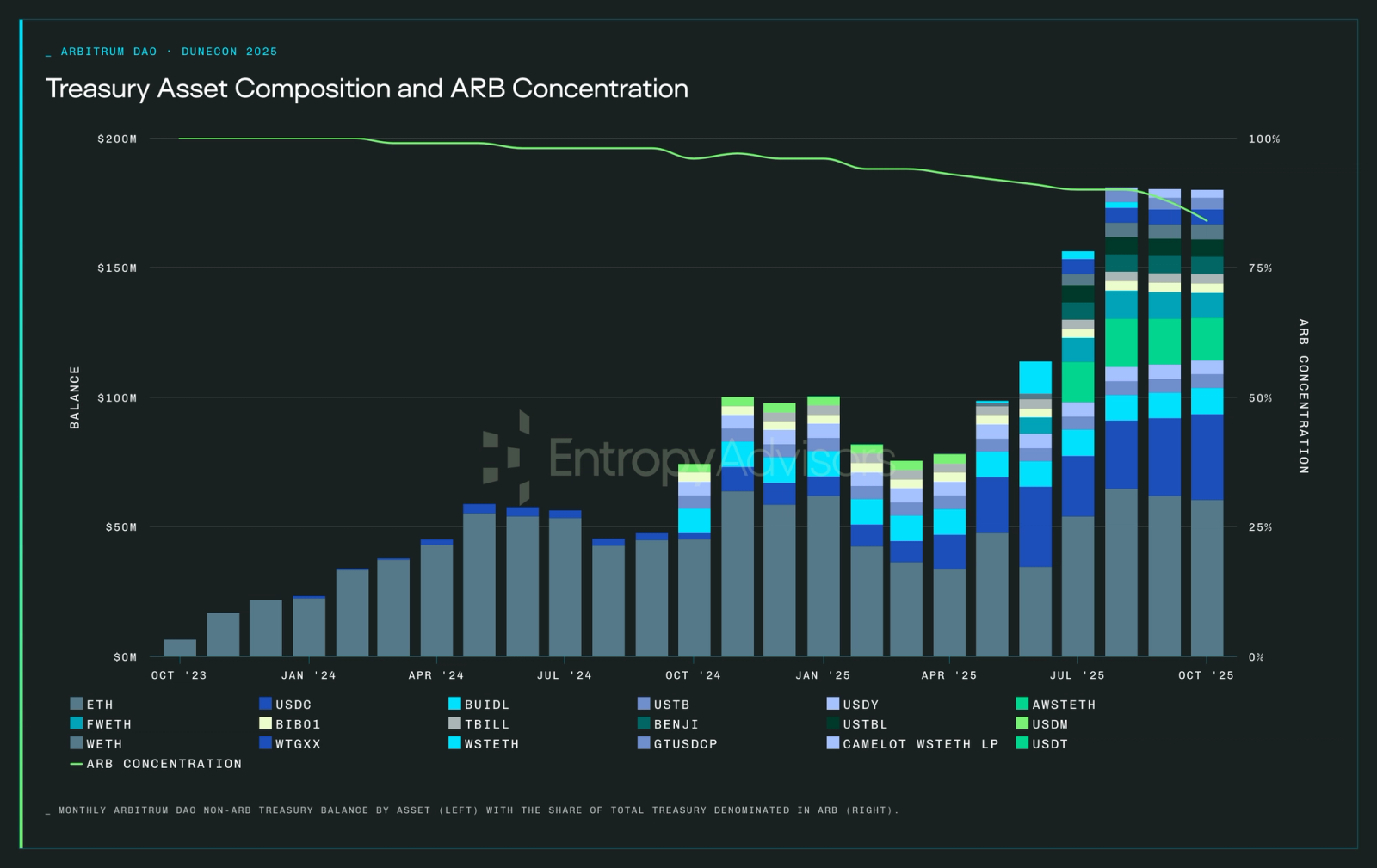
Throughout most of its history, the treasury was heavily ARB-concentrated, which made it highly sensitive to market volatility and sell pressure as a result of expenditures.
The numbers tell the story clearly: at its peak, the ARB in the treasury was worth over $7 billion in early 2024, but by the end of last month, its value had fallen to under $1 billion.
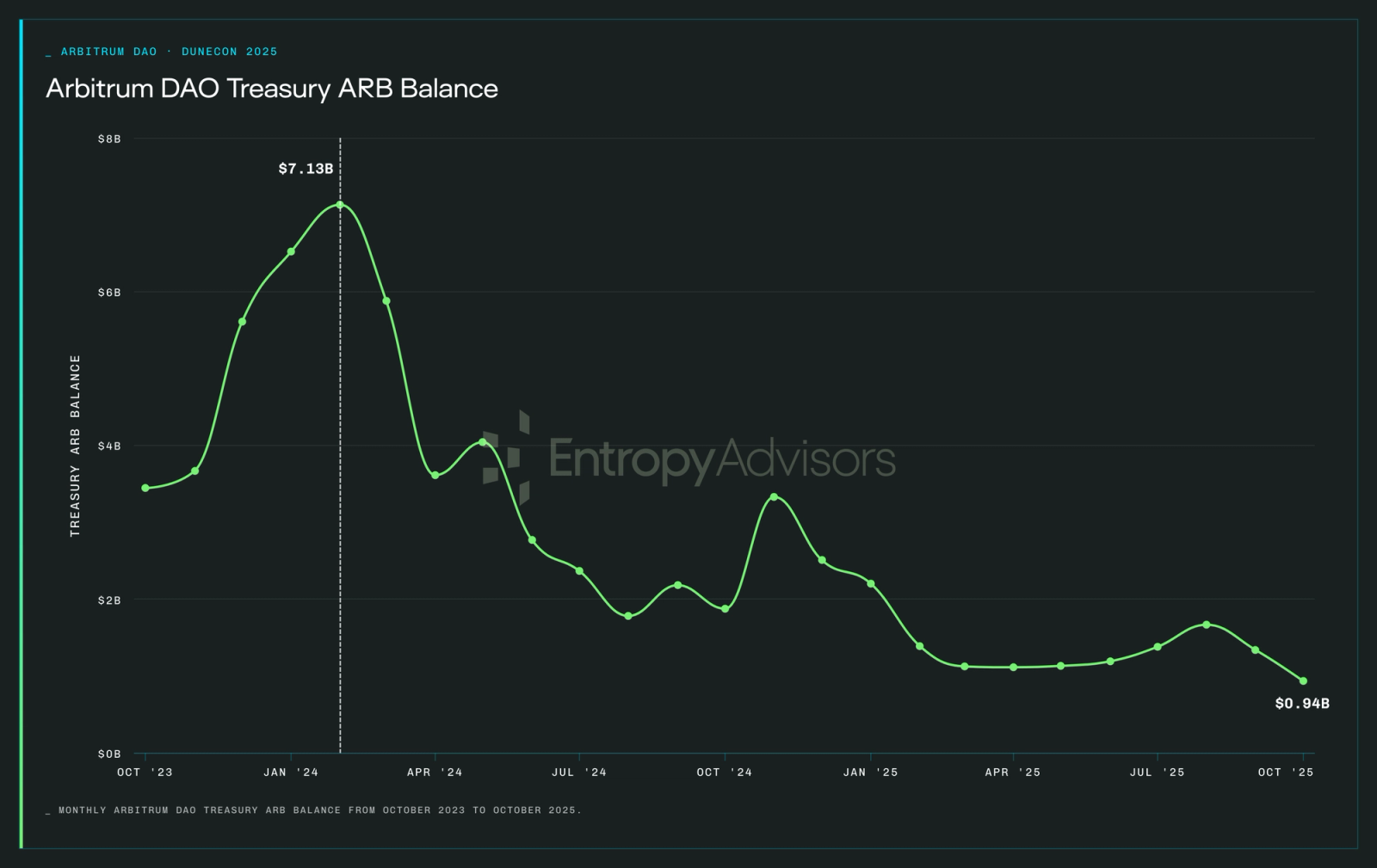
It is also worth noting that treasury ARB should be treated as an unissued asset. The DAO's true financial capacity is lower than the nominal value it would realize from a hypothetical full liquidation, because the act of liquidating would itself move the market.
The solution, in short, is diversification. The DAO needs multiple revenue streams to fund its operations rather than depending on the ARB it holds.
Four Revenue Streams, Up from Two
Arbitrum DAO originally had two sources of revenue:
- Transaction fees from selling block space on the Arbitrum network
- Orbit licensing fees paid by chains built on the Arbitrum tech stack through the Arbitrum Expansion Program
But Arbitrum now has two other revenue streams as well:
- Timeboost, a transaction-ordering mechanism introduced in April of 2025. It uses a sealed-bid, second-price auction to capture a portion of the network's MEV. Users bid for priority access, and the revenue flows to the DAO, with a small share routed to the Arbitrum Developer Guild.
- The Treasury Management Program, an initiative designed to facilitate ecosystem growth while improving the financial stability and capacity of the DAO's treasury through strategic asset management.
The results speak for themselves. Despite transaction fees still being the main revenue contributor, the DAO has successfully transitioned from pure transaction fee dependence to a model where around 30% of revenue comes from Timeboost and interest earned through the treasury management program.
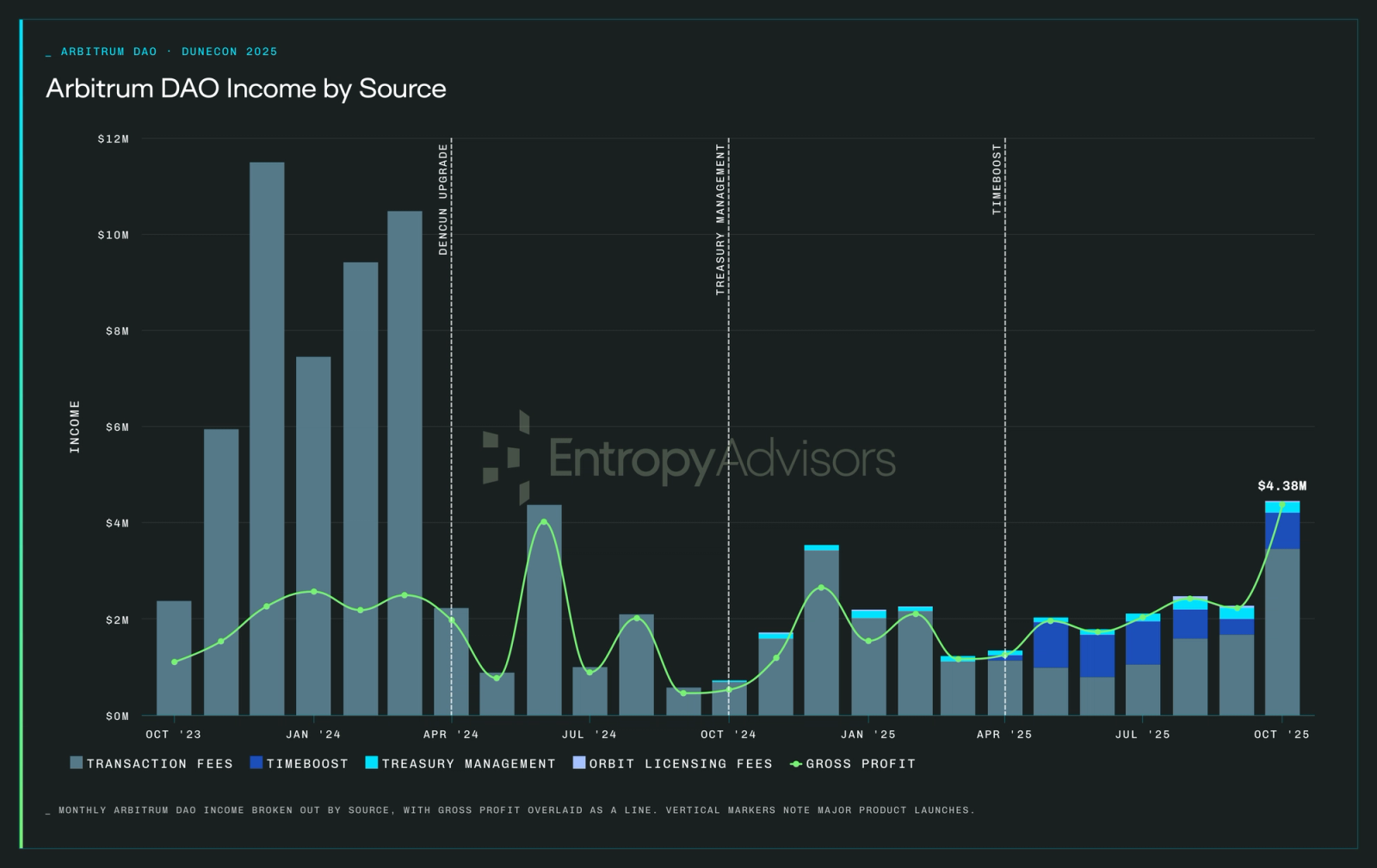
Even after the Dencun upgrade and the introduction of blobs reduced transaction-fee revenue, the cost of revenue (primarily sequencer fees) dropped proportionally. Gross profit has stayed stable, and with new revenue sources online, it is trending upward.
Inside the Treasury Management Program
The Treasury Management Program is also where the DAO's diversification effort becomes most concrete. Its goal is to deploy ETH and stablecoins from the treasury, across a range of strategies.
As of November 2025, more than $85 million has been deployed across three categories:
- Real-world assets (predominantly tokenized treasuries)
- ETH and ETH-correlated assets
- Stablecoins
These positions generated roughly $1.68 million in cumulative interest over the past year. The DAO recently approved an additional allocation of 8,500 ETH, accrued from transaction fees and Timeboost bids, to the Arbitrum Treasury Management Council for future deployment.
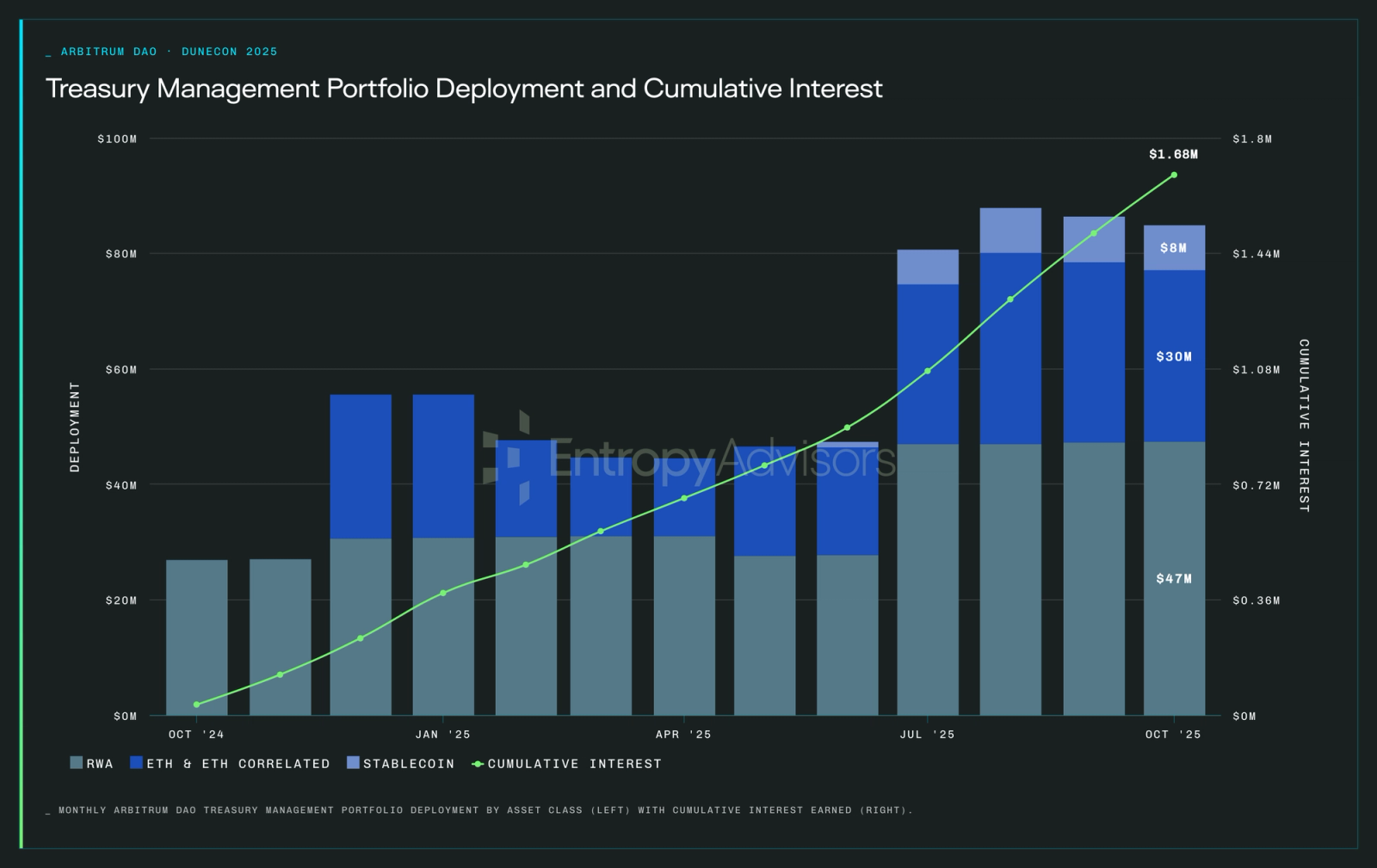
This Council, of which Entropy is a member, aims to optimize for both treasury diversification and ecosystem growth while optimizing for higher yields. We recently published an investment policy statement that serves as our framework for investment decisions. The goal is to balance growth and yield generation while carefully managing risk and ensuring deployment longevity.
Where the DAO Stands Today
The composition of the treasury has changed materially over the DAO's lifespan. ARB reliance has been reduced by roughly 15%, and the treasury now holds:
- $180 million in ETH LSTs and LRTs
- A diversified mix of stablecoins
- A growing allocation to real-world assets, which have been particularly useful for both diversification and yield
Looking forward, the Arbitrum Expansion Program is poised to play a larger role. As chains like Robinhood build on the Arbitrum tech stack and gain traction, the licensing revenue and ecosystem expansion they generate should become an increasingly significant contributor to the DAO's revenue and balance sheet.
A Data-Driven Path Forward
Every milestone covered here, from revenue optimization to treasury diversification, has been the product of data-driven decision-making. Entropy's view is that data is not just a tool for governance work. It is the foundation for building a more resilient, transparent, and financially sound DAO. All of the treasury positions and returns can be tracked on arbdata.com
Working on treasury strategy, incentive design, or governance for a DAO or onchain organization? Entropy Advisors partners with protocols and ecosystems on treasury management, data analytics, and execution. Get in touch to learn how we can help.