
This post is a condensed version of our full DRIP Season 1 retrospective. The complete report, including additional detail on program design, execution, and data, is available here.
Introduction
The thesis of DRIP Season 1 was simple. Looping is the key driver of lending market activity today, and targeting this very specific behavior translates to deeper liquidity, higher utilization, and higher lending rates across Arbitrum lending markets. That, in turn, makes Arbitrum a more attractive chain for new lending markets, asset issuers, and those looking for yield on stables, including wallets, CEXs, and fintech earn products.
The bet underneath the program was that lending markets are one of the highest-leverage pieces of DeFi infrastructure for a chain to invest in. They sit upstream of stablecoin demand, yield product distribution, and asset issuance. A chain with deep, liquid, competitive lending markets becomes a natural home for new asset issuers and for any team building products that need reliable onchain credit. A chain without them does not. DRIP Season 1 was structured around that view.
DRIP Season 1 differed from past Arbitrum incentive programs in three key ways:
Honed scope. DRIP Season 1 concentrated on a single behavior: looping. Within that focus, incentives were even further constrained to a set of lending markets and a set of assets, allowing capital to be deployed intentionally. Past programs spread incentives broadly across protocols and use cases, on the theory that letting the market sort it out would surface the highest-impact deployments. Season 1 took the opposite view, that a tightly defined target produces clearer signal and more deliberate outcomes.
Competitive and iterative. The program was explicitly competitive, with asset issuers and lending markets evaluated against each other and incentive allocations adjusted based on biweekly performance data. The program had flexibility baked into it to adjust with results and changing market conditions. Rather than committing to fixed allocations for the full season, the committee retained the ability to reweight as data came in.
Top-down planning. DRIP is centrally coordinated by a committee composed of Entropy Advisors, Offchain Labs, and the Arbitrum Foundation. This structure was put in place to enable faster iteration and management aligned with Arbitrum's adjacent programs and broader goals. It also meant the program could move quickly when the competitive or market environment shifted, without waiting on a broader governance cycle for each operational decision.
Our view is that this tightly scoped, performance-based, and actively managed approach outperformed the broader, static, protocol-led incentive programs Arbitrum has run previously. That said, there were wins, losses, and lessons learned along the way, and this case study walks through all three.
The Pre-Launch Playbook
Incentive programs are won and lost in the planning phase. By the time capital starts flowing, most of the decisions that determine outcomes have already been made.
Entropy proactively engaged incentive-related service providers to assess needed skills and tooling. Firms including Chaos Labs, Gauntlet, Merkl, RoyCo, and Platonia participated in early discussions, allowing the DRIP committee to compare approaches across program modeling, incentive distribution infrastructure, and monitoring before any capital was deployed. The diligence process also clarified where in-house judgment was needed versus where external tooling could be relied upon. We negotiated preferred commercial terms with Merkl, which materially reduced operational overhead and laid the foundation for a productive working partnership. Distribution is one of the less glamorous parts of running an incentive program, but it determines how cleanly a program can execute.
In parallel, our team conducted outreach to dozens of teams across the DeFi and looping ecosystem to understand what constraints mattered most and what differentiating features were available on the market. This feedback informed asset selection and incentive design, and surfaced which yield-bearing stable issuers were ready to scale on Arbitrum, which lending markets had technical roadmaps that aligned with the program timeline, and which integrations would need to be pulled forward to make the season viable.
We also brought integration partners into the planning phase rather than treating integrations as an afterthought. We needed launch dates for Euler and Morpho, mechanisms to easily get in and out of new yield-bearing stables like thBill, syrupUSDC, and SUSDC (DEX liquidity or native minting), and Pendle markets ready to go. Coordinating this in parallel rather than in sequence is part of why Season 1 launched with a usable product set in place from day one.
A Framework for Performance-Based Allocation
The problem is common across incentive programs: large pools tend to default toward size-based allocation, subjective judgment, or growth metrics that reward unsustainable behavior. The solution was a Multi-Criteria Decision Analysis (MCDA) framework utilizing an Analytical Hierarchy Process (AHP), which transforms strategic preferences into consistent and reproducible allocation outcomes.
Rather than optimizing for a single metric, the framework scored protocols across six dimensions:
- Size: current Arbitrum deposits
- Growth: expansion during the measurement period
- Market: Arbitrum share relative to other networks
- Utilization: borrow activity against total deposits
- Efficiency: growth per ARB spent
- Breadth: eligible asset diversity
Each metric was normalized to create comparable scores, ensuring that rapid growth in smaller protocols received appropriate weight alongside the scale advantages of larger ones. Rather than assigning weights by intuition, stakeholders compared each dimension through structured pairwise comparisons, with a mathematical consistency check built in. The output was a composite utility score per protocol that reflected performance across all dimensions.
One of the framework's most important design choices was the separation of KPIs from constraints. Total market size, for instance, acted as a feasibility ceiling, not a performance metric. This prevented the model from automatically rewarding scale and instead directed incentives toward growth and efficiency. The distinction between what we wanted to reward and what was realistically achievable is what made the framework function as a strategic allocation tool rather than a simple leaderboard, with strategic priorities remaining objective, transparent, and defensible.
Season Overview
Season Structure and Allocations
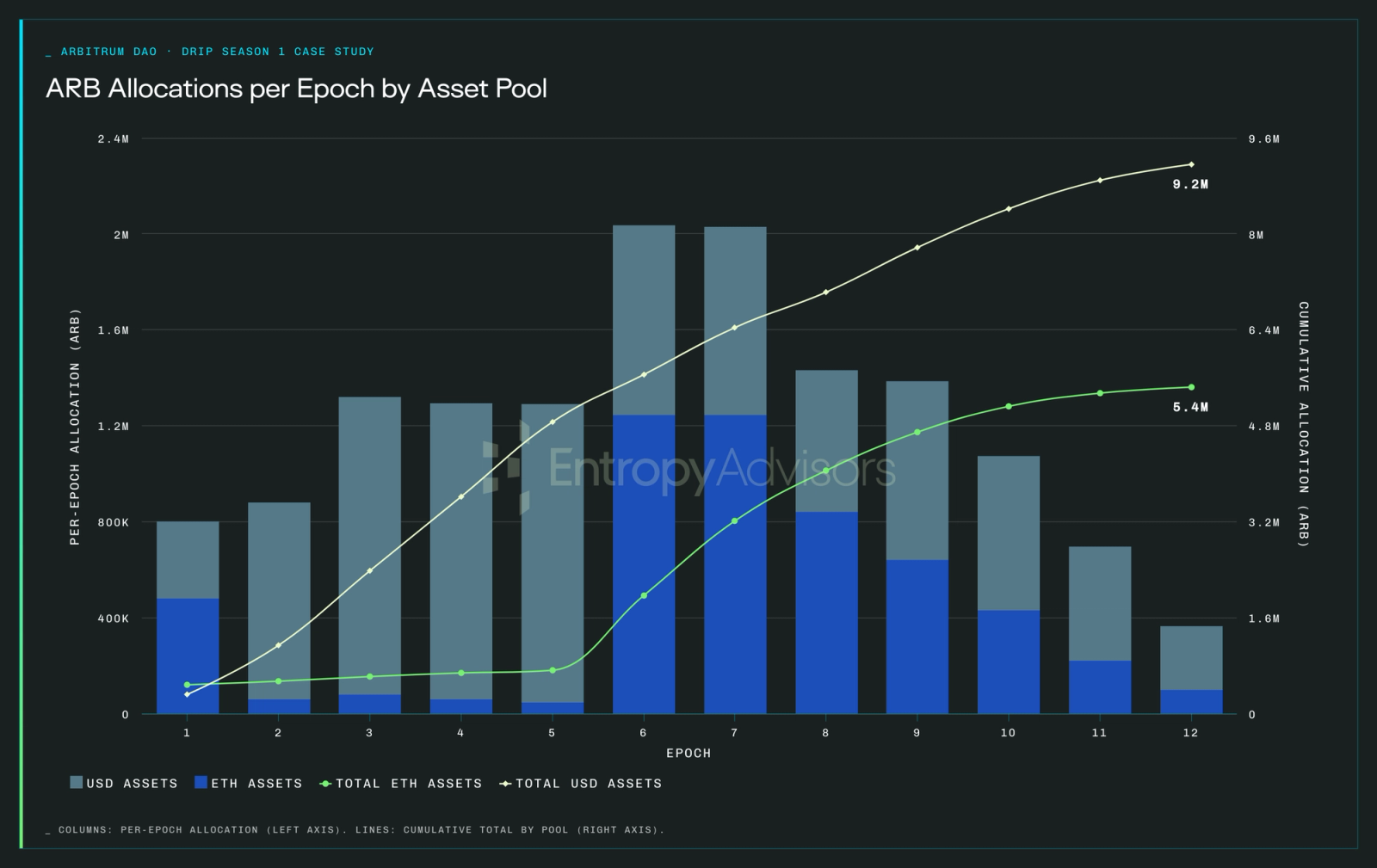
Season 1 launched on September 3rd, 2025 and spanned 12 two-week epochs till February 18th, 2026. The first two served as a discovery phase, while the final four a taper phase.
Pre-season planning and coordination resulted in the selection of six lending protocols as Season 1's core participants: Aave, Morpho, Fluid, Euler, Dolomite, and Silo. Two asset pools were defined to be incentivized simultaneously throughout the season:
- ETH assets: Lido's wstETH, EtherFi's weETH, Renzo's ezETH, Kelp's rsETH, and GMX's gmETH.
- USD assets: Spark's sUSDC and sUSDS, Ethena's USDe and sUSDe, Maple's syrupUSDC, Resolv's RLP and wstUSR, Theo's thBILL, USD.AI's USDai and sUSDai. InfiniFi's siUSD and Reservoir's wsrUSD were added later in the season.
The initial budget was 16M ARB with an additional 8M ARB discretionary allocation. In practice, 14.6M ARB was deployed (approximately $4M at the time of allocation) and distributed across participating protocols and asset pools. Of that total, USD-pool assets received 9.16M ARB and ETH-pool assets received 5.44M ARB.
Cost Effectiveness
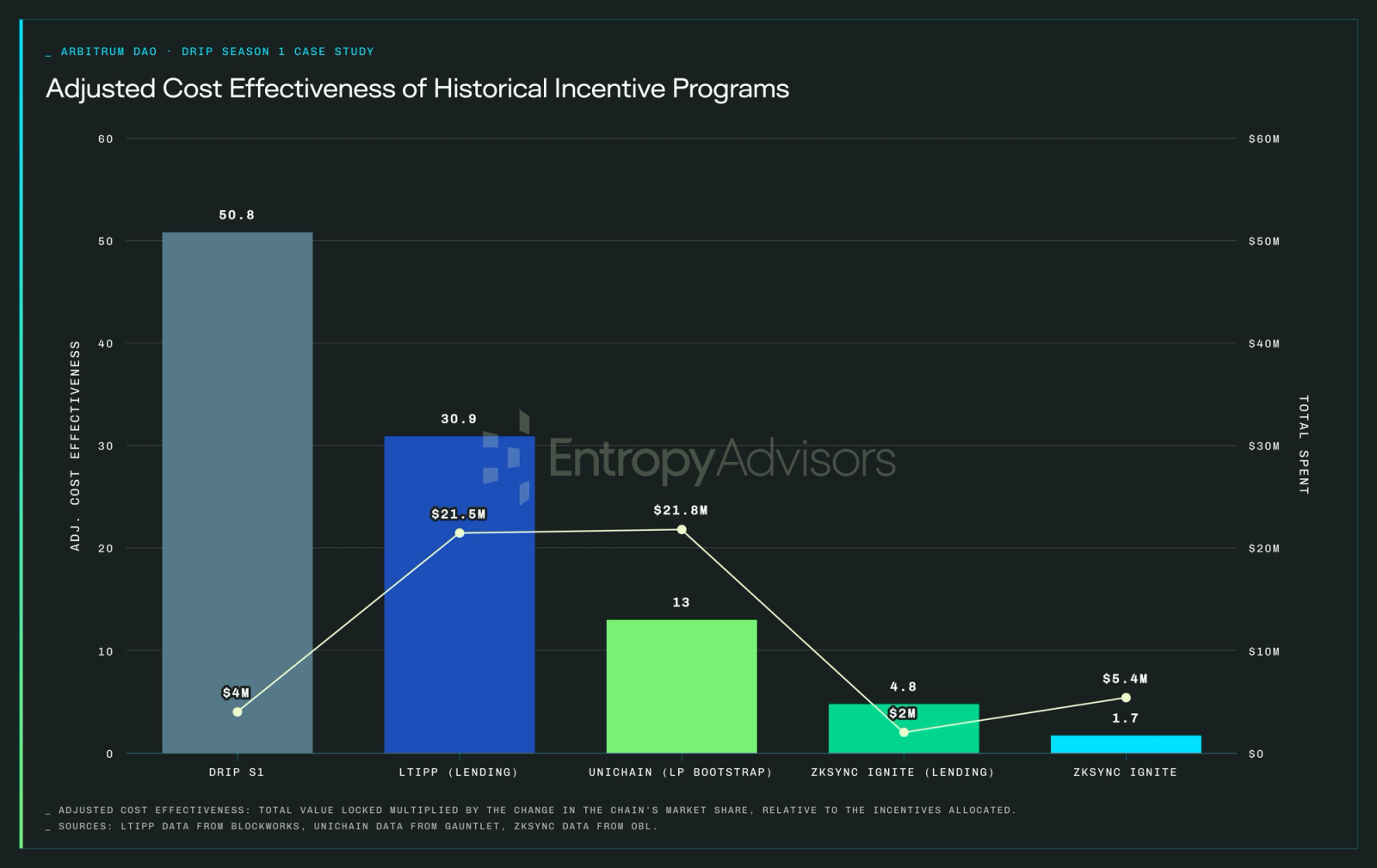
To measure capital efficiency, our team used an adjusted cost effectiveness metric, calculated by taking the total market size of participating protocols across all chains, multiplied by the change in their Arbitrum market share, relative to the dollar value of ARB allocated. This approach isolates Arbitrum-specific gains from broader market movements, which matters given that ETH price declined over 50% during the season.
The adjusted ratio came in at 51 across the full season, meaning that for every $1 of ARB deployed, the Arbitrum total market size of participating lending protocols grew by $51. For USD assets, the unadjusted metric was used since stablecoin-denominated markets are largely insulated from broader price fluctuations, reaching a cost effectiveness of 76.
It is worth noting that differences in protocol architecture, asset coverage, and non-uniform allocation splits between ETH and USD pools mean protocol-level figures are not directly comparable. The aggregate metric is also market-size weighted, which means Aave (the largest participant) only receiving ETH allocations negatively skews the combined figures.
To put these numbers in context, we benchmarked DRIP Season 1's adjusted cost effectiveness against comparable incentive programs. DRIP achieved the highest adjusted cost effectiveness at 51, while deploying significantly less capital than most peers, with just $4M compared to LTIPP's $21.5M and Unichain's $21.8M budgets. While each program operated under different market conditions and with different objectives, the comparison reinforces the case that focused, actively managed incentive deployment can deliver meaningfully better capital efficiency than broader, higher-spend approaches.
Market Penetration
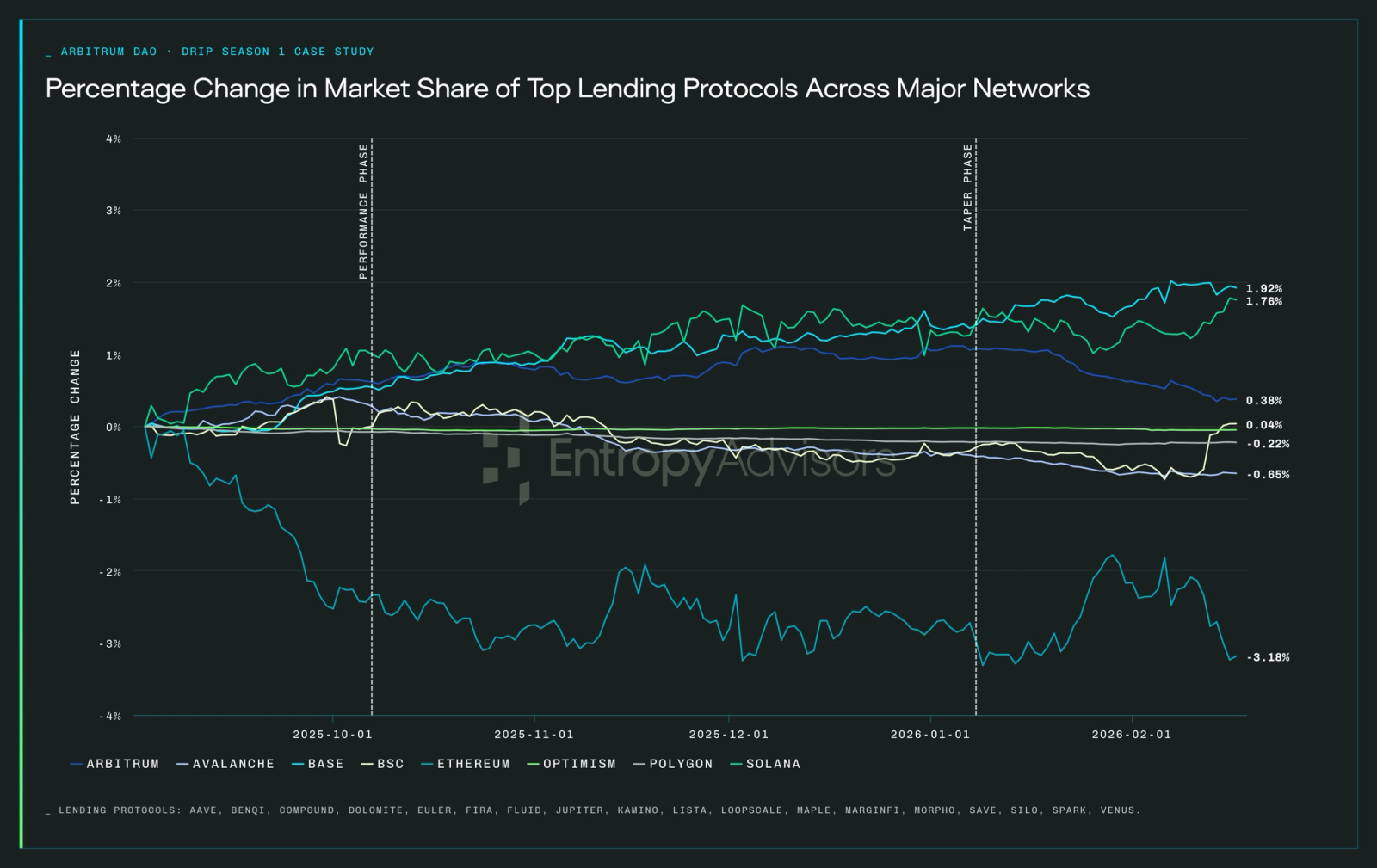
In a declining market, total value locked will inevitably fall across the board, and evaluating an incentive program purely on that basis conflates external conditions with program outcomes. A more meaningful measure is whether the program grew Arbitrum's share of the overall lending market and captured a larger slice even as the pie shrank.
To assess this, we tracked the percentage change in lending market share across major networks over the Season 1 period, using the first DRIP day as a baseline and aggregating data from the largest lending protocols on each chain. Multiplying these percentage changes by the total market size of top lending protocols across each chain at the end of the program produces a market penetration figure, representing the dollar value gained or lost by each network as its market share expanded or contracted.
Despite the broader market downtrend, Arbitrum ended the season with a 38 basis point gain in market share, translating to approximately $266M in market penetration. In other words, had Arbitrum's market share remained flat, the total lending market size on the network would have been $266M lower than the $2.1B recorded at the end of the season.
Base and Solana's gains during this period coincide with ongoing, large incentive campaigns from Coinbase, Jupiter, and Kamino respectively, with budgets that significantly exceeded DRIP Season 1's allocation. Given Ethereum's 3.1% reduction in market share over the same period, much of those networks' growth could be attributed to capturing Ethereum's declining share. This also highlights a key challenge for future seasons: competing for retention during taper phases is difficult when rival networks are sustaining higher levels of spend.
Outcomes and Ecosystem Impacts
The headline metrics tell part of the story, but the more durable outcomes from Season 1 are the structural changes to Arbitrum's lending ecosystem that the program helped catalyze. DRIP's biggest win wasn't captured in any single chart. It was the expansion of what's possible on Arbitrum. Protocols and assets that were previously challenging to onboard are now live on the network, expanding the DeFi landscape and giving users a wider range of strategies to deploy. The downstream effect was a flywheel, where fresh liquidity activated deeper DEX pools and opened the door to yield tokenization, reinforcing growth across adjacent verticals and strengthening Arbitrum's position as a leading DeFi destination.
Expansion of the Lending Ecosystem
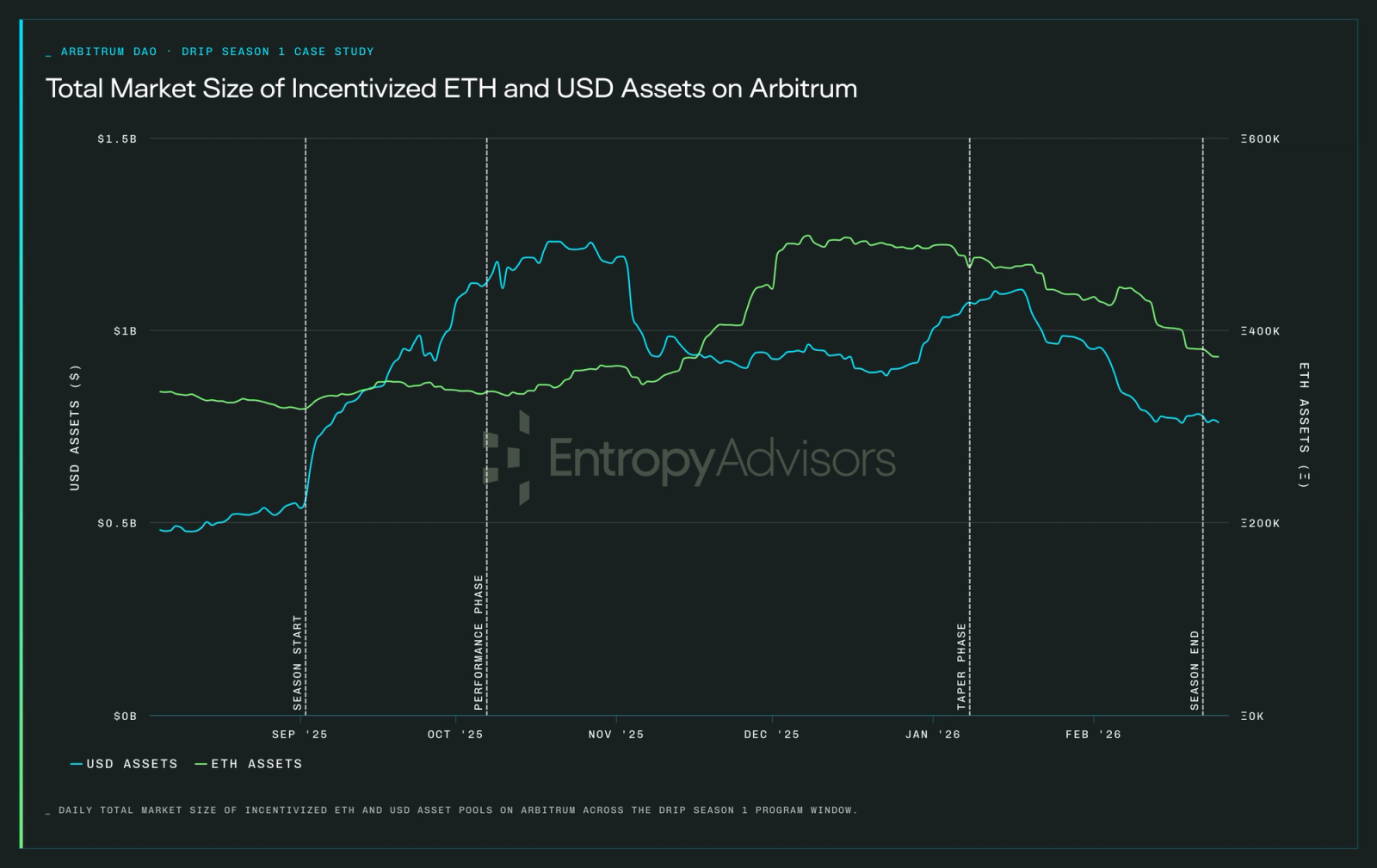
Season 1 incentives drove growth across both ETH and USD asset markets on participating lending protocols. The total USD asset market increased by approximately 38%, reaching around $770M by the end of the season. ETH-denominated market size grew by 25% in ETH terms, reaching approximately 400K ETH.
DRIP also directly catalyzed the launches of Morpho and Euler on Arbitrum. With Aave, Morpho, Compound, Fluid, and Euler now all live, Arbitrum is hosting every major EVM lending protocol, totaling $2B in combined market size. This was a deliberate goal: bringing a wide range of earn campaigns, yield-bearing stablecoin issuers, and liquidity providers catered to all sorts of user preferences. The result is a lending and looping ecosystem well equipped to serve a much broader user base than before.
Growth of Yield-Bearing Stablecoins
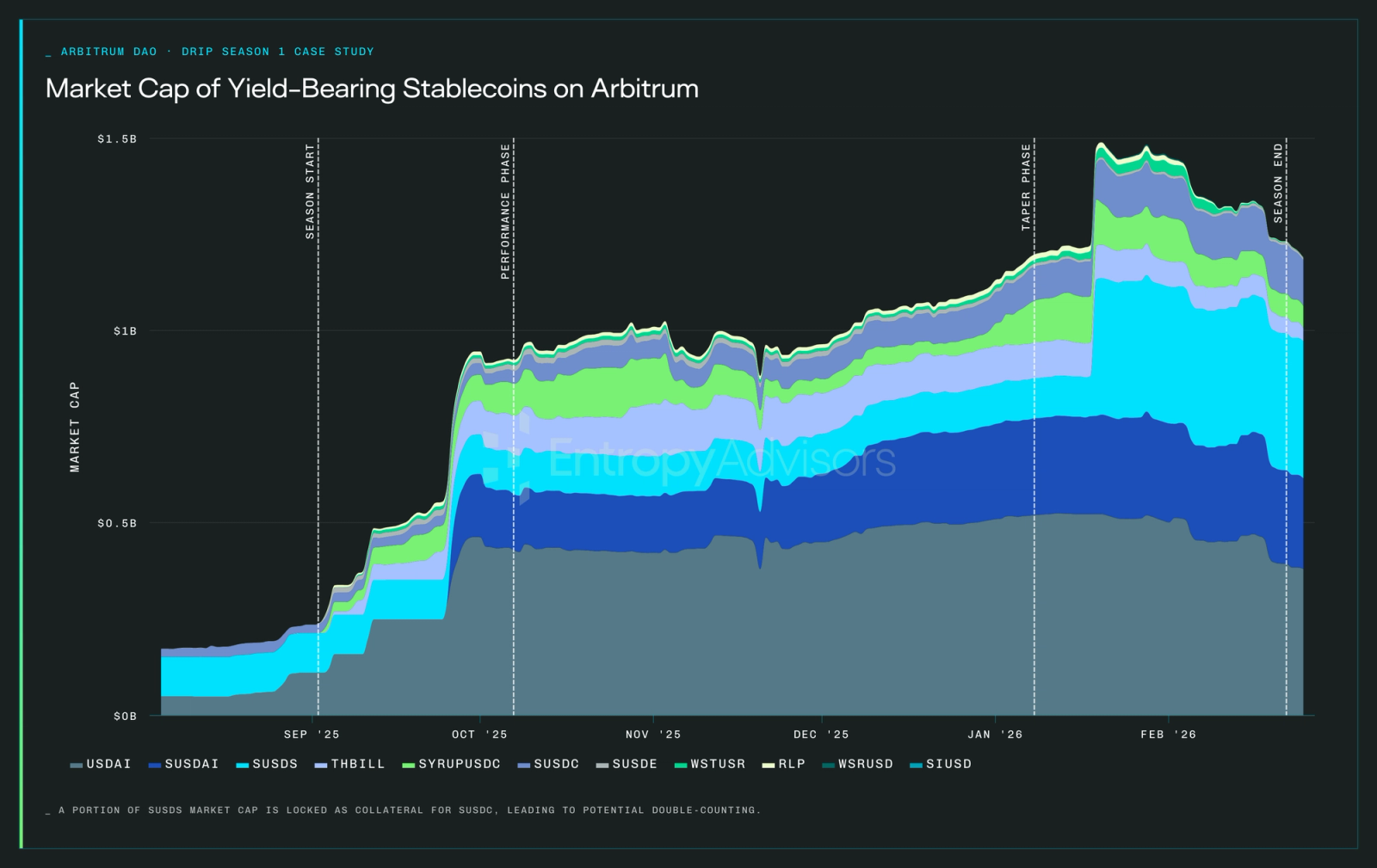
One of Season 1's clearest wins was the expansion of Arbitrum's yield-bearing stablecoin supply, which grew from a $130M market to one with $1B+ worth of assets at the end of the program. Spark, Maple, Theo, and Resolv each brought their assets to the network, complementing the existing presence of Ethena, Sky, and USD.AI. The result is a broader and more diverse stablecoin landscape that has strengthened structural borrow demand and made Arbitrum a more compelling destination for DeFi lenders, wallets, fintech platforms, and structured yield products.
Higher ETH Supply and Borrowing Activity
Prior to DRIP, Arbitrum's ETH circulating supply was declining and losing ground to Base. Despite ETH incentives being paused early in the season, Arbitrum not only stayed ahead of Base and Linea but also reversed the trend, and is now on an upward trajectory with over 840K ETH circulating on the network. The downstream effect was evident: a large share of this inflow entered lending protocols, lifting both supply-side and borrow-side liquidity by roughly 40%.
Deeper DEX Liquidity
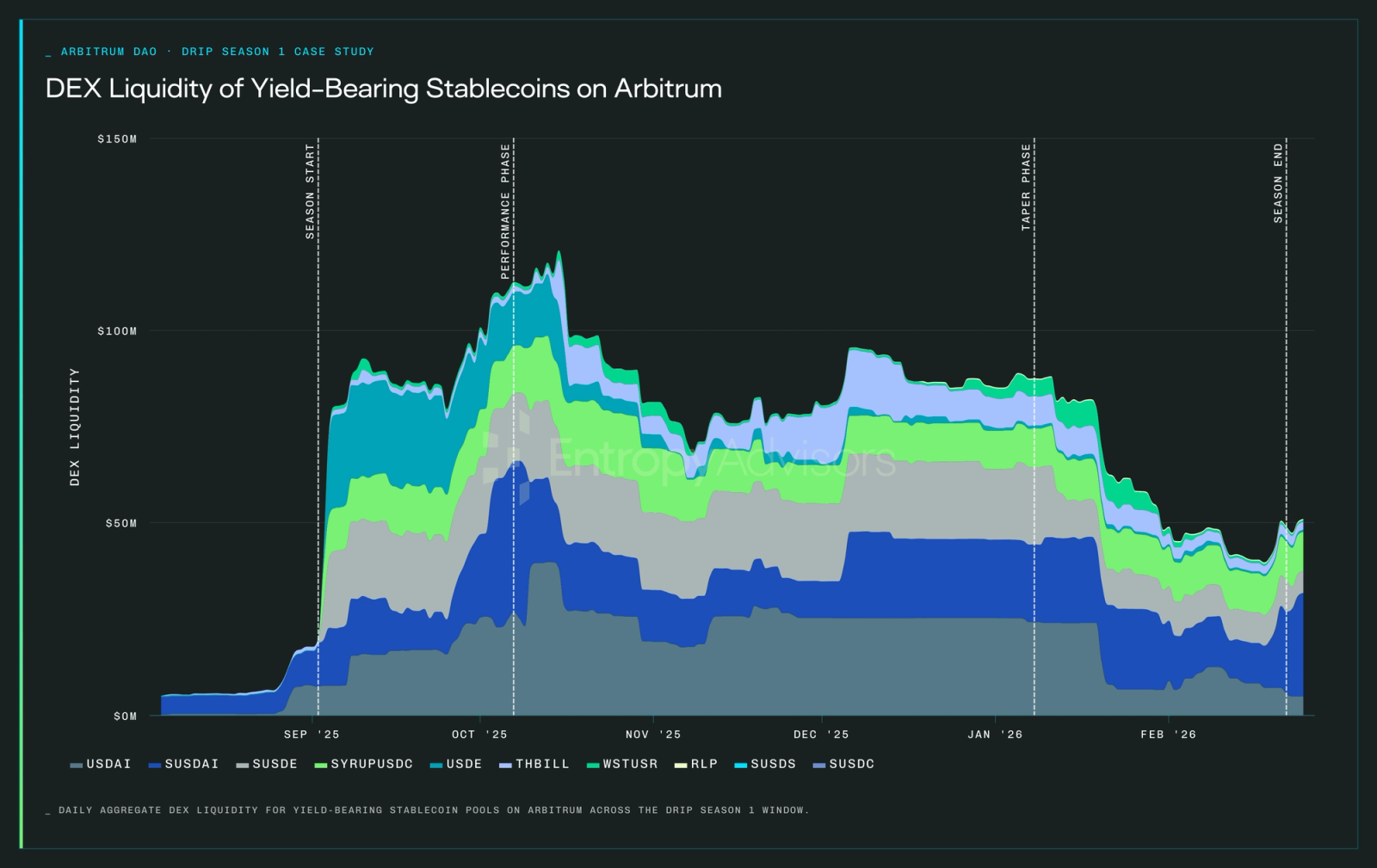
Bringing new assets to Arbitrum naturally deepened their DEX liquidity, as decentralized exchanges serve as a primary acquisition channel. Liquidity grew from $20M to $120M at peak, reducing friction for users and making yield strategies more viable at scale. Liquidity depth matters not only for rates but for liquidations, user confidence, and loop execution efficiency. While DEX liquidity has retraced toward the end of the program, capital has not left the network. Instead, it has migrated to other protocols. Ethereal alone has captured over $60M in USDe since its public launch, with a significant share flowing into Pendle for pre-TGE point strategies and higher yields.
Tokenized Yield Integration
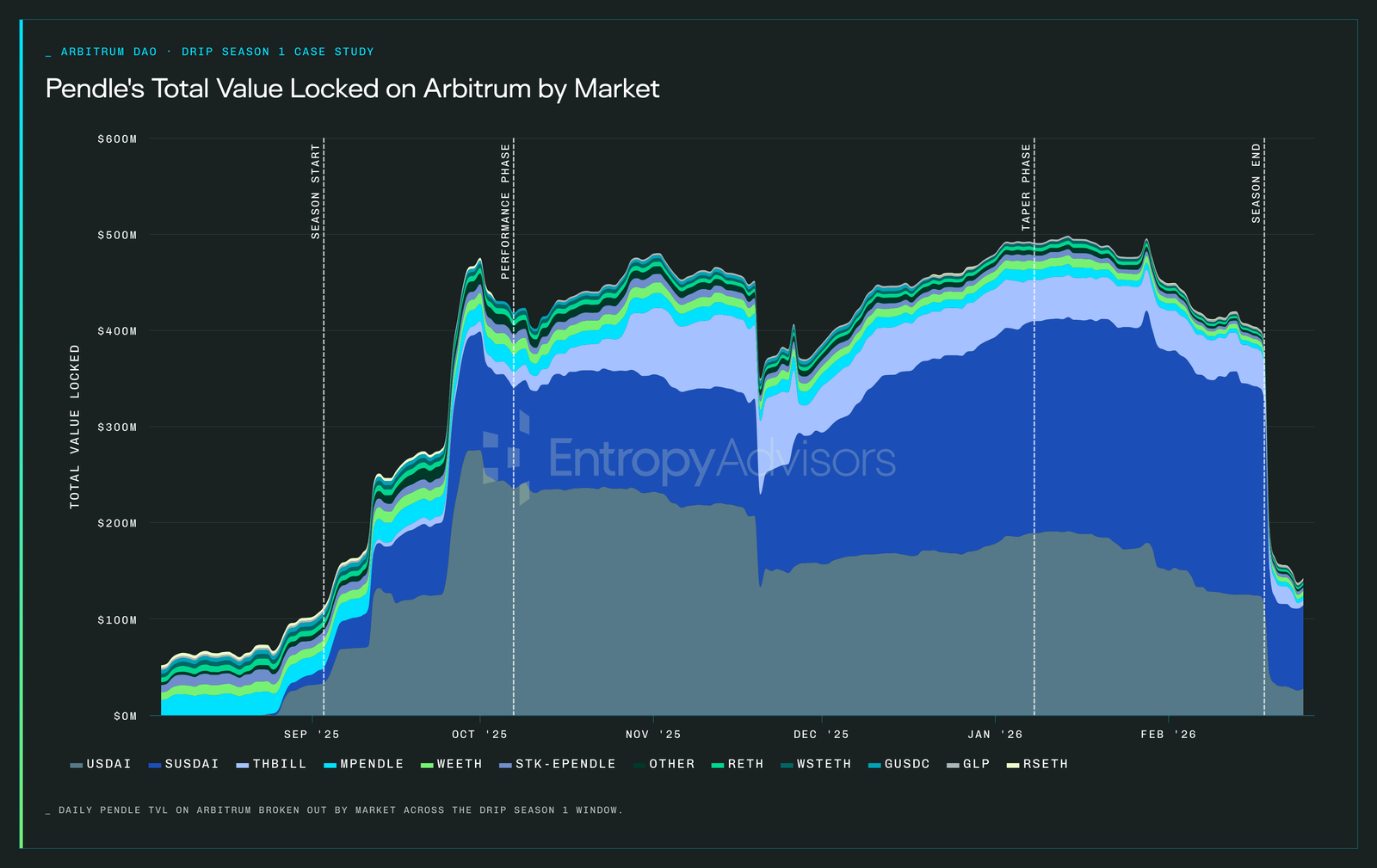
Yield tokenization emerged as one of the most strategically significant developments during Season 1. Pendle markets on Arbitrum peaked at close to $500M in combined TVL, led by USD.AI's USDai and sUSDai alongside Theo's thBILL. While TVL has since retraced, driven largely by market expiries, subsequent rollovers, and declining interest rates for these assets, the value of this primitive goes beyond headline figures. Early signs from the late February rollovers suggest continued demand, reinforcing our view that the impact will persist. Splitting assets into principal and yield components gives vault managers and risk curators significantly more flexibility in how they construct and manage lending positions, opening the door to a wider range of collateral types that would be difficult to integrate through traditional lending structures alone.
Headwinds and Challenges
Adverse Market Conditions and Competitive Timing
On October 10, extreme volatility triggered widespread deleveraging and liquidations across the industry, with large participants rapidly withdrawing capital from lending markets. USD-denominated loops weathered the storm without mass liquidation; had the season focused on volatile asset collaterals, the outcome could have been very different.
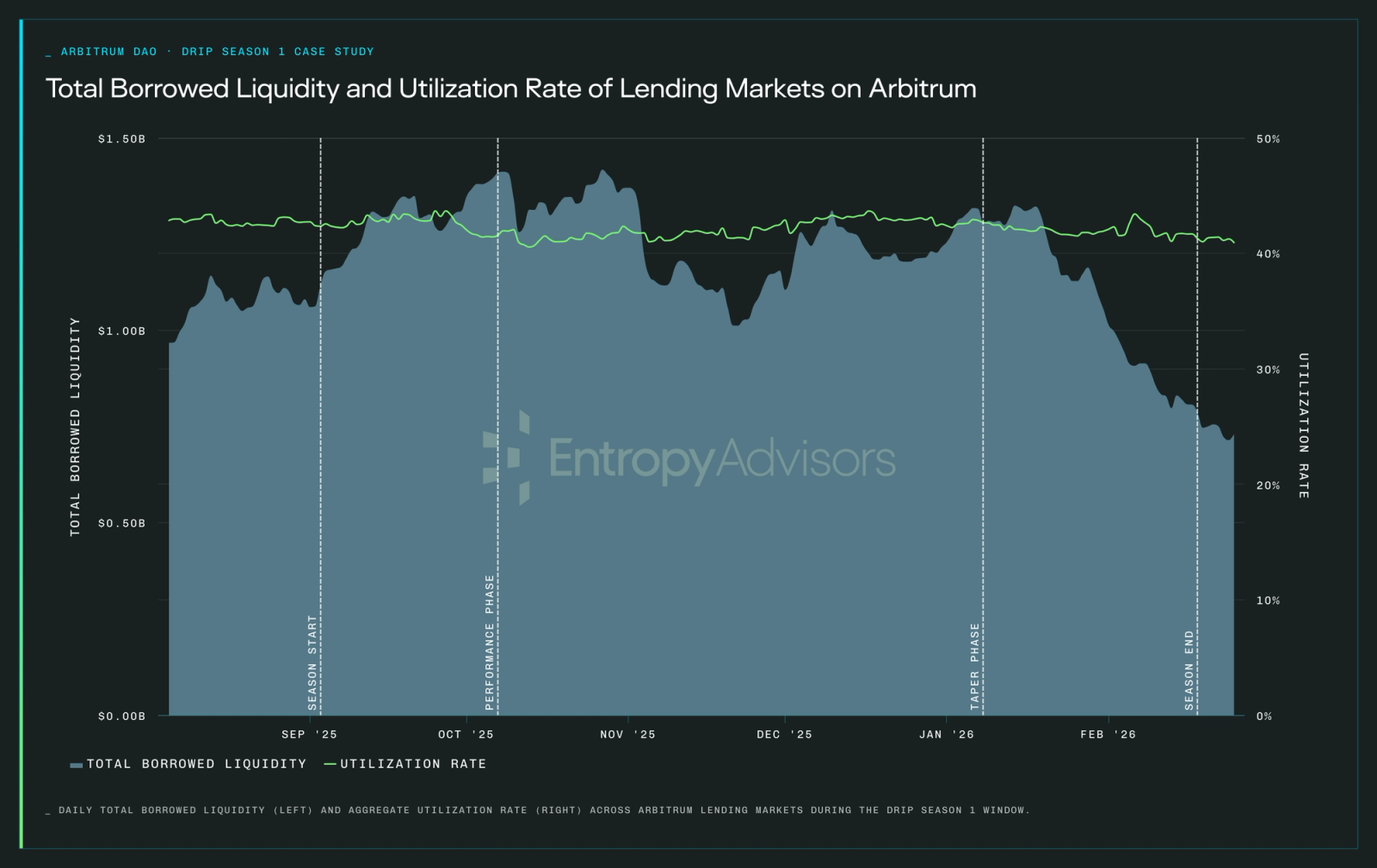
Conditions worsened later in the month when Stream Finance collapsed, triggering a pronounced risk-off shift across yield strategies. For a program built around stimulating leveraged borrowing, the timing was difficult. Participants spent the rest of October and beyond actively unwinding leverage or avoiding new deposits. Total borrowed liquidity declined, though utilization rates held relatively flat, indicating supply-side withdrawals tracked borrowing declines closely. A brief recovery in late December and early January offered some relief, but renewed price declines and deteriorating market sentiment from late January onward weighed on activity once again.
Competitive timing was a separate but compounding challenge. ETH-based incentives were deliberately paused after epoch 1 and not restarted until epoch 6, because Linea was aggressively deploying ETH incentives at the start of the program and competing directly was not an efficient use of capital. A similar dynamic emerged with Plasma on USD assets, though its sole USDT focus left more room for DRIP to compete effectively. The compressed ETH incentive window likely limited long-term retention, and Season 1's experience showed that even more dynamic control over incentive intensity and duration would have been valuable, particularly in response to competitive shifts.
What DRIP Season 1 Demonstrated About Incentive Design
DRIP was envisioned to challenge the status-quo of incentive program design, and Season 1's results validated the core elements of that approach. Tightly scoped programs outperform broad ones. Actively managed allocations with real adjustment cadence outperform static distributions. Coordinated planning across incentive strategy, distribution infrastructure, integrations, and marketing produces better outcomes than treating any of those pieces as an afterthought. The structural changes to Arbitrum's lending ecosystem (Morpho and Euler launching, the growth in yield-bearing stable presence, deeper DEX and routing liquidity, retention of ETH borrow activity beyond active incentive periods) are evidence that this approach works when applied to the right targets.
The season also clarified what incentive programs cannot do. They cannot create demand for products that do not have product-market fit. They cannot sustain mature markets indefinitely without diminishing returns. They cannot be run effectively without distribution infrastructure that actually covers the venues being targeted, or without pre-committed rules for when underperforming allocations get cut. The discipline in any future program is matching the design to the conditions where incentives have genuine marginal impact, and being willing to walk away from deployments where they do not.
Debt asset liquidity, not deposits in the abstract, is the lever for growing lending markets. Incentives produce their highest returns at the 0-to-1 phase of market development. The program is most effective when paired with teams that have already found product-market fit. These are the principles Season 1 surfaced most clearly, and they generalize beyond Arbitrum and beyond lending. Any ecosystem running an incentive program is making implicit bets on these questions, and getting them right is the difference between durable growth and rented TVL.
One direction that emerged late in the season points to where this work can go next. A partnership between Bitget, Morpho, and Steakhouse coordinated CEX distribution, lending infrastructure, and vault management to provide users with flexible onchain earning options while opening potential revenue channels for the DAO. A small portion of DRIP budget was allocated for this arrangement, which sat outside the original scope of the program. The model is worth highlighting because it points to something incentive programs rarely achieve on their own: structures where the activity being incentivized produces revenue back to the entity funding it. Future seasons will build on this foundation and explore arrangements where incentivized participants contribute directly to DAO revenue through fee-sharing, performance-based commitments, or similar mechanisms. Incentives should not only grow the ecosystem but generate tangible returns for the DAO that funds them.
Entropy is Evolving Incentive Program Design
Designing and running programs like DRIP is part of what Entropy does. Our work with Arbitrum DAO spans treasury management, incentive design, data analytics, and execution on programs that require coordination across protocols, service providers, and governance. The skills that made DRIP Season 1 possible (diligence on service providers, negotiation of commercial terms, integration planning, biweekly performance review, real-time allocation adjustment, coordinated communications) are skills we have built up through extended operational work inside an onchain ecosystem rather than from the outside.
The lessons from Season 1 are not Arbitrum-specific, and most of them apply directly to any onchain ecosystem trying to deploy capital for structural growth rather than headline metrics. Get in touch to learn more about how Entropy approaches incentives.